— Standard Poorly · est. 2026 · free indicator publication —
658 signals refreshed daily — from 2-year Treasury yields to McRib launches — scored for how often they predict what SPY does next, and only marked “validated” if the pattern still holds up on data we hadn't shown the model yet. Plus every public-market call the All-In, BG2, Sohn, and Grant's Conference hosts have made, translated into per-host portfolios you can audit.
“That All-In stuff is incredible — something I’ve been trying to get out of ChatGPT for a while. When can I get the full ledger and alerts?”
— Jeff F. · All-In listener · fintech founder
Live right now
Three live snippets from the publication, right now — so you can see what you'd be reading before you click in.
Fired this week · 0
Quiet week — no indicators have crossed the fire threshold in the last 7 days.
Most weeks are quiet — check back Monday.
see every fire →Pundit ledger · all-in hosts
All-In hosts are beating SPY by 7.1 percentage points across 4 per-host books.
3 of 4 hosts beat SPY individually
317 public-market calls graded
Every position carries the episode + transcript timestamp.
New All-In episode
Every episode of every pod we track gets transcribed, extracted, and graded against SPY.
Transcription desk is at work on the newest episode. Every call gets pulled from the transcript, graded against SPY, and filed with its receipt — usually live within hours of air.
full pundit ledger →What this is
A daily indicator publication
658 leading indicators across 24 sectors, recomputed every morning. Each one shows how often it correctly predicted SPY's next move (the hit-rate), the average size of that move, and whether the pattern still held up when retested on fresh data. Browse the catalog or just read
today's page — the strongest fires bubble to the top.
A pundit accuracy ledger
Wonder what would have happened if you'd followed the hosts of a podcast you actually listen to? We track every public-market call the All-In, BG2, Sohn, and Grant's Conference hosts have made for six years — find the optimal methodology for each host (some are short-term, some swing, some buy-and-hold) — and show you what their book would have done vs SPY. Receipts on every position: episode + transcript timestamp.
Open the books →A chat that talks to the data
Ask plain-English questions about any stock, sector, indicator, or the underlying data — with live news context pulled in for the named tickers. “Which of my watchlist names co-fired this week?” “What's the Chamath book up YTD?” Ships with Analyst tier at launch.
Tier details →Two ways to read it
Same data, two skins. Pick whichever fits your mood or what you're trying to do — flip whenever.
Skin · Almanac
You're in this skinRead it like the Sunday paper.
Editorial, easy on the eyes, one piece at a time. Cream paper. Serif type. Italic kickers. The publication you open with coffee.
STANDARD · CURRENCIES_RATES · SP-1805
2-Year Treasury Yield
4.08 ↑ 8% vs 6w ago
Short-end of the curve Fed-policy expectations.
Last fired 7 days ago
When this fires, SPY averaged −6.0% over the next year — moving in the opposite direction 64% of the time.
Use it when: Browsing what fired this week · Reading a pundit ledger · Catching up after a few days away
Stand at the back of the room and watch every screen.
Information-dense, action-oriented, Bloomberg-style. Dark canvas. Mono type. Amber for live, cyan for selected. The cockpit when you're working a position.
2Y_TREAS · SP-1805● LIVE
4.08 +8.0% Δ30D
short-end · fed expectations
[STRONG] 6,331 obslast fire d+7
Use it when: Scanning for fires intraday · Comparing horizons in one glance · Acting on a setup before it cools
Same data, both skins. Flip whenever you want — the toggle's up top in the masthead, or press K. Your choice sticks across visits.
Ask the universe
Plain-English questions about any stock, sector, indicator, or the data + editorial behind it — with live news context pulled in for the named tickers. Here's what the answers look like.
YouWhat's happening with NVDA right now? Give me context from news, related signals on the stock and sector, and anything a pundit has said recently.
Standard Poorly · data chat
NVDA is moving on three signals worth flagging:
SIGNALS
Two semi-sector indicators are firing this week — SOXX RSI(14) and industrial production · semi facilities. Historical hit rate on the pair is 67% at 1mo, average forward move +3.2%.
PUNDIT LEDGER
Brad Gerstner opened a long-NVDA position 14 days ago on BG2 Pod (episode + transcript receipt available). Chamath trimmed in mid-April but still net long. Cross-pod aggregate is +71% on the name over 3 years.
NEWS
Last 24h: 6 headlines, sentiment slightly positive. Top item is a Benzinga note on hyperscaler capex guidance — the same data point that triggered SOXX RSI above.
HISTORICAL
The pattern firing now has occurred 47 times since 2018. 64% followed by positive 1mo SPY-relative returns. Drawdown floor is −7.4% on the bad ones — set your stop accordingly.
Sources: SP indicator catalog · /pundit-poorly/all-in · Alpaca/Benzinga news API · backtest engine. Click any callout for the underlying detail.
You could also ask:
QHow far back does the data go for the McRib indicator?
Daily series from January 2014 onward — 11 years of menu-availability records cross-referenced with McDonald's earnings windows. Earliest 'fire' (cross-check the 30-day rolling z-score crossing 2σ) was March 2014.
QWhat horizons does the engine analyze?
Six canonical: 1d, 1wk, 1mo, 3mo, 6mo, 1yr — recomputed against SPY for every signal. Analyst tier unlocks custom horizons from 1 to 504 trading days, plus the engine's tuned 'natural horizon' (often outside the canonical 6).
QWhat's the sector skew of All-In picks by year?
Aggregated across 4 hosts: 38% tech (heaviest 2020-22), 17% crypto/Bitcoin-adjacent, 12% biotech, 9% energy, balance spread across consumer + financials. Year-by-year breakdown + per-host attribution available on the All-In aggregate page.
Preview · ships with AnalystThe data chat opens with the Analyst tier. Drop your email on the waitlist and we'll ping you the moment a founder-rate seat opens.
Join the Analyst waitlist →How to read an indicator
Every indicator card carries the same five answers. Once you can read one, you can read every one of the 658.
Step 1
What it measures
A publicly observable signal — Treasury yields, App Store ranks, weather, search trends. We compare today's number to the last 180 days to spot when it moves unusually (in stats-speak: a z-score).
Step 2
When it fires
When today's reading is unusually big or small relative to the last 180 days (|z| above 2.5 — rarer than ~99% of normal days). Fires are tagged with the date and which direction.
Step 3
What SPY did next
The average S&P 500 move over the next day, week, month, quarter, six months, and year after the signal fired. All six shown side-by-side so we can't cherry-pick the one that looks best.
Step 4
How often it works
Hit-rate (how often the next move went the predicted way) compared to a 50/50 coin flip — with how likely the pattern is luck (the p-value) and how many past fires we measured (the sample size).
Step 5
Whether it still works on fresh data
A green ✓ means the pattern held up when retested on dates the model hadn't seen yet (out-of-sample, OOS). A red ✗ means it broke — and we still publish those, marked failed, so you see what didn't survive.
Standard vs Poorly
The editorial wedge. Every indicator falls into one of two buckets, and the split is the publication.
Standard
The signals a Bloomberg terminal would carry.
e.g. Treasury yields, CNN Fear & Greed, CPI prints, sector P/E ratios, options-skew, EPA industrial production.
Rigorous quant signals tied to standard economic categories. These are the ones you'd use to read the actual macro tape.
Poorly
The signals nobody else is tracking — yet.
e.g. nationwide weather impacts on US markets, McRib and bitcoin (and pork futures), Mercury retrograde, lunar cycles, trending app store downloads by sector, etc.
Lifestyle / search / weather / chaos / culture / sports indicators. Curiosity-driven — most won't survive multiple-testing burden. The ones that do are interesting.
Pundit tracking
We watch every public-market call from the pods + conferences you already listen to (or wish you did), extract them from transcripts, mark the date+price the host actually spoke at (not the pod release date), and build per-host portfolios. Then we benchmark each book against SPY over the same window. Here's the All-In ledger, live:
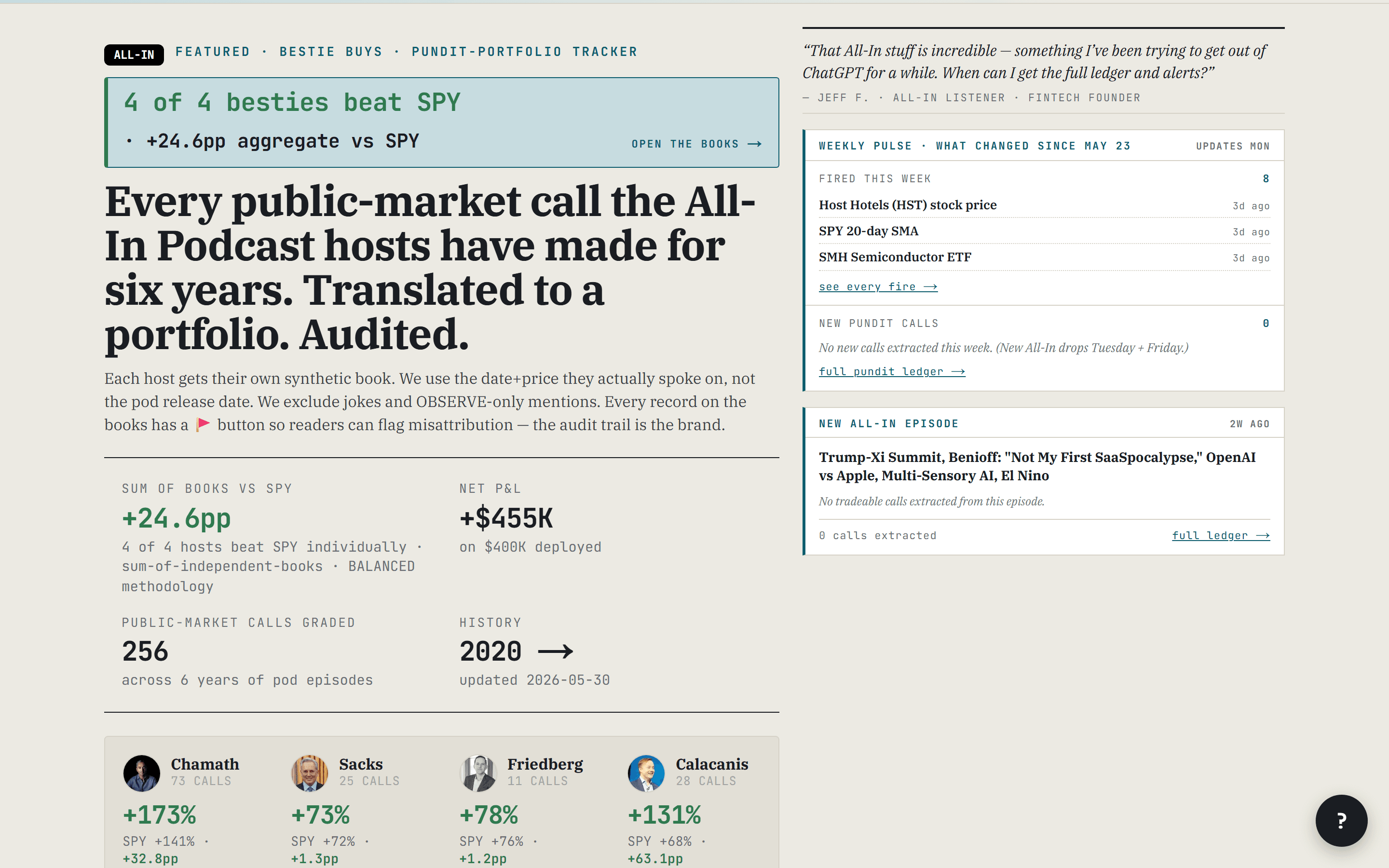
ALL-INFeatured · Bestie Buys · pundit-portfolio tracker
3 of 4 besties beat SPY· +7.1pp aggregate vs SPYOpen the books →Every public-market call the All-In Podcast hosts have made for six years. Translated to a portfolio. Audited.
Each host gets their own synthetic book. We use the date+price they actually spoke on, not the pod release date. We exclude jokes and OBSERVE-only mentions. Every record on the books has a 🚩 button so readers can flag misattribution — the audit trail is the brand.
Sum of books vs SPY
+7.1pp
3 of 4 hosts beat SPY individually · sum-of-independent-books · BALANCED methodology
Net P&L
+$429K
on $400K deployed
Public-market calls graded
317
across 6 years of pod episodes
History
2020 →
updated 2026-09-21
Independent · not affiliated with All-In Podcast · editorial / nominative use
new · tipping hallpundit + ledger join · receipts inline · audit-hall correctable
We catch the moment they talked their book.
The trade ledger is public (STOCK-Act PTRs, SEC 13Fs). The pod transcripts we already ingest are public. Put them next to each other and a new question becomes answerable: did the senator name NVDA on All-In before they bought NVDA? We scan the disclosure window between trade execution and disclosure for public statements that named the traded ticker. Receipts inline. Community- reviewed. The trade ledger is how we know, not the headline.
Open the tipping hall →What else is on the site
A walk through every nav destination — what each page does, what you click first when you land. Real screenshots, not mockups.
Today · /today
The daily Standard Poorly publication.
- Featured pundit ledger up top — All-In hosts vs SPY, plus per-host books.
- Live news, sector movers, today's firing signals, weather + macro pulse.
- Weekly Pulse tells you what's changed since you last visited.
Visit Today →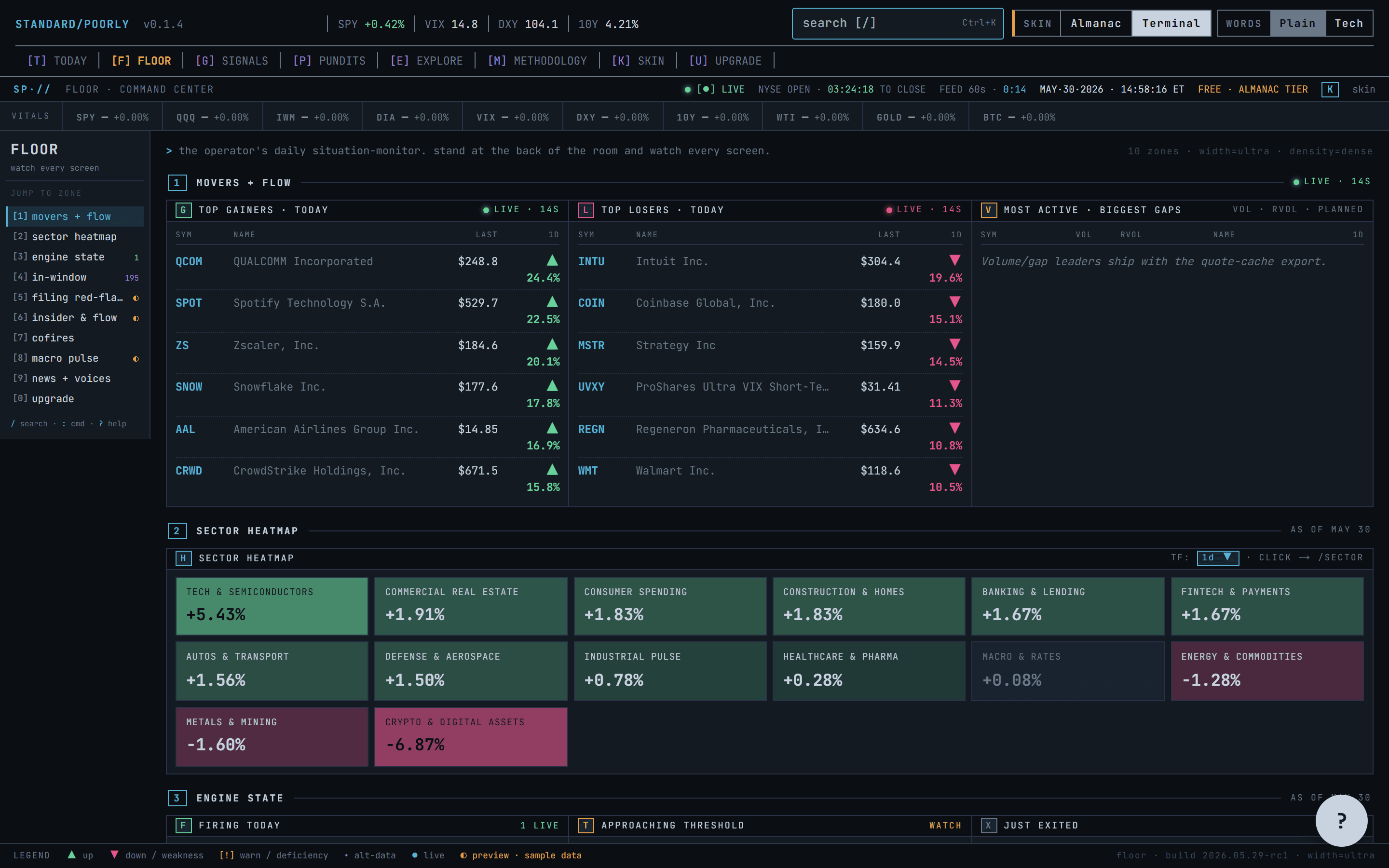 Terminal skin
Floor · /floor
Stand at the back of the room and watch every screen.
- Multi-ticker dashboard — biggest gainers, losers, sector heatmap, watchlist all visible at once.
- In-window predictions sortable by days remaining + confidence.
- Free-tier flagship; paid tiers add watchlist anchoring + custom alerts.
Visit Floor →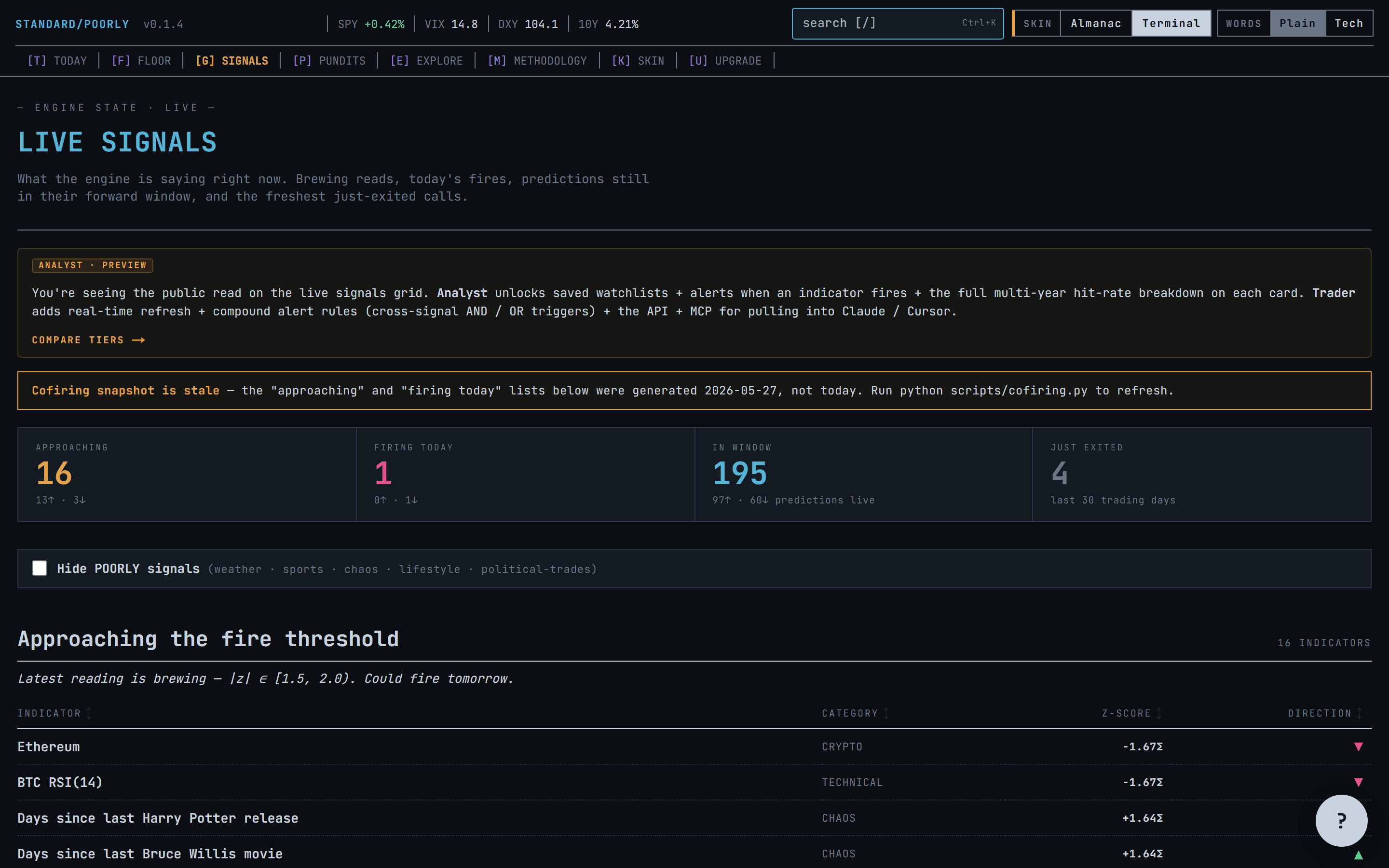 Terminal skin
Signals · /signals
What the engine is saying right now.
- Four tiers: Approaching · Firing today · In window · Just exited.
- Sortable columns; filter out the chaos / Poorly indicators if you want a quant-only view.
- Every row deep-links to the underlying indicator detail.
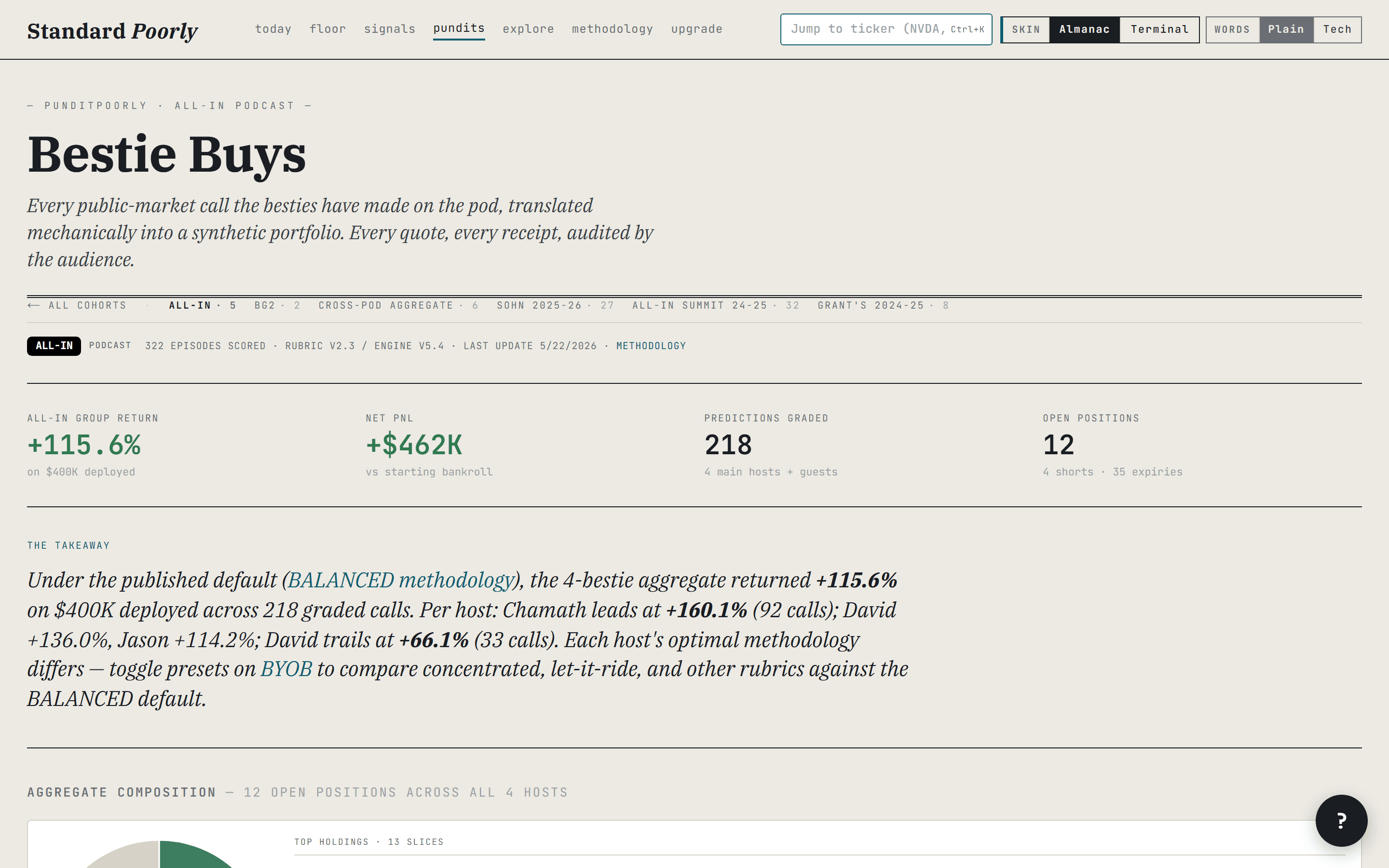
Visit Signals →Pundits · /pundit-poorly
Every public-market call, ledgered with receipts.
- Per-host portfolios for All-In, BG2, Sohn, Grant's Conference, cross-pod aggregates.
- Episode + transcript timestamp on every position.
- Dispute mailto on every page if you spot a misattribution.
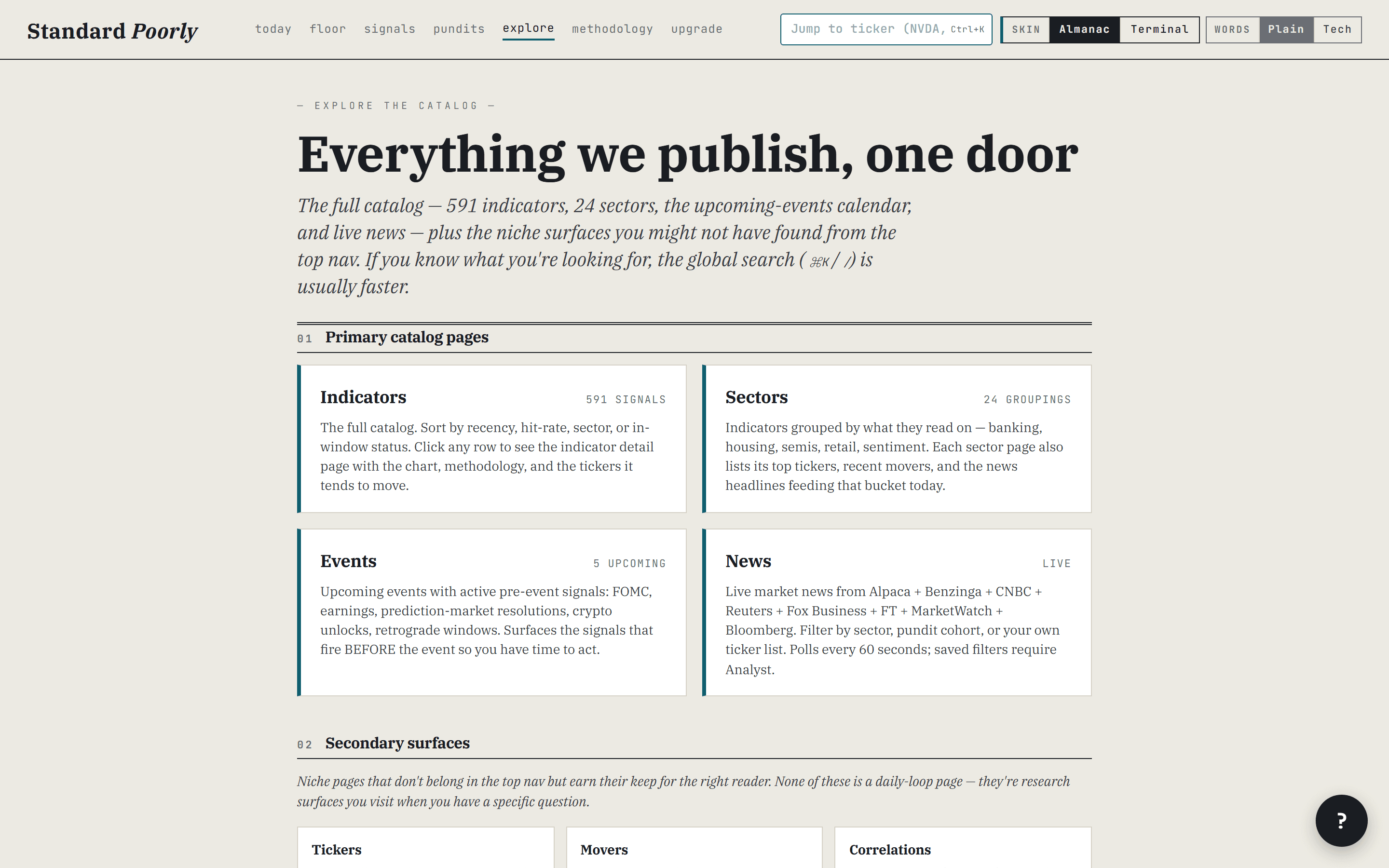
Visit Pundits →Explore · /explore
The full catalog, one door.
- Indicators, sectors, events, news — primary destinations laid out as cards.
- Secondary surfaces (Movers, Composites, Correlations, Cofires, Tickers, Metros) one click in.
- Use the global search (⌘K) if you know what you're hunting for.
Visit Explore →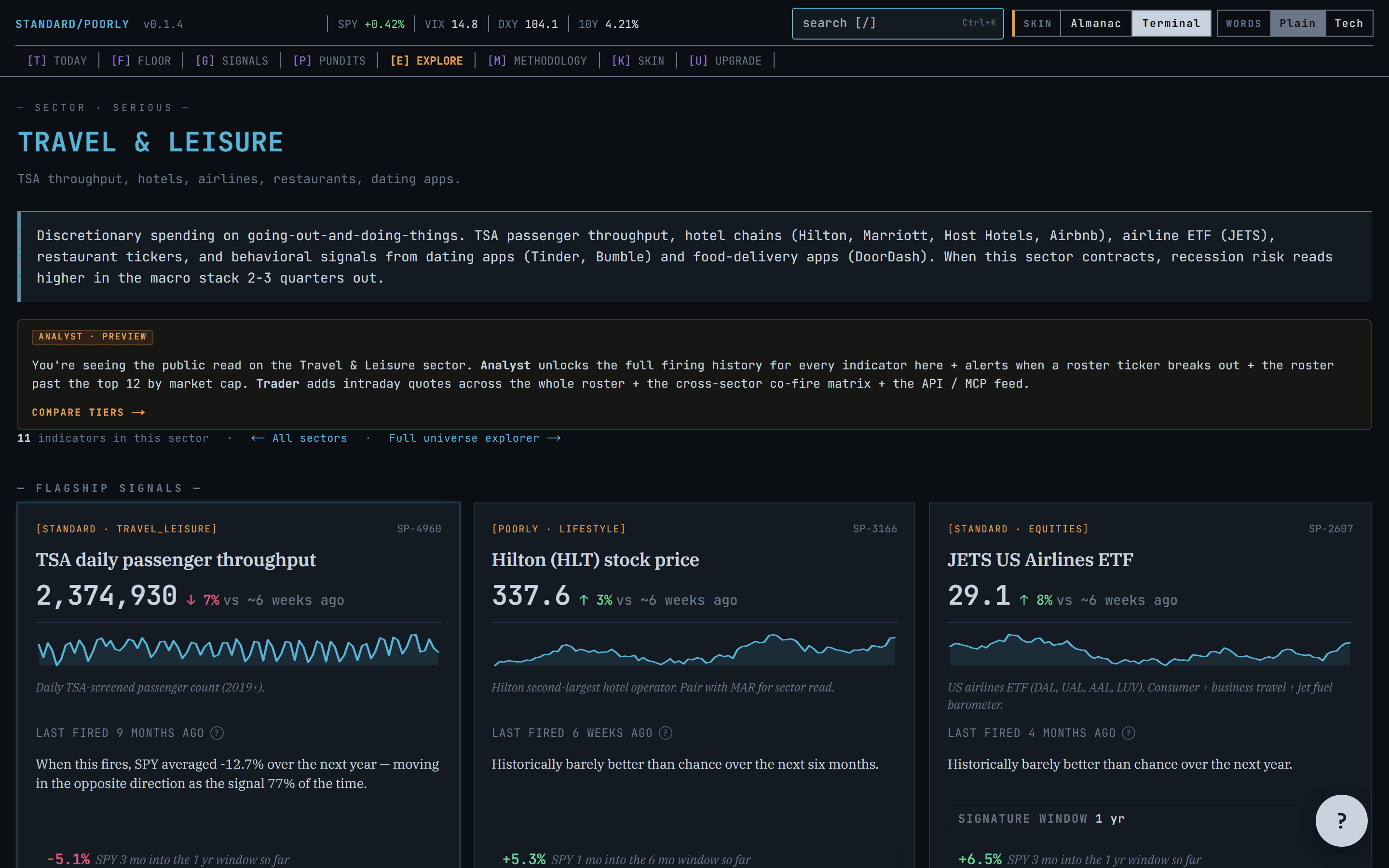 Terminal skin
Sectors · /sector/travel-leisure
Every sector, the way a desk reads it.
- Live roster + 7-day movers + a mood ring for each of 24 sectors (Travel & Leisure shown).
- Mapped indicators firing in the sector, plus wire news and curated commentary.
- Reads dense in Terminal, editorial in Almanac — same data, your call.
Visit Sectors →How the math works
- Spot the unusual day, then watch what SPY does. We measure how much today's reading differs from the last 180 days (a z-score). When the move is bigger than ~99% of normal days (|z| above 2.5), we call it a fire.
- Six time horizons, no cherry-picking. We track what SPY did 1 day, 1 week, 1 month, 3 months, 6 months, and 1 year after each fire — all six numbers side-by-side. If a signal works at 1 day but breaks at 3 months, you see both.
- Grade 1–10 is a percentile rank. 10/10 = top 10% of indicators we publish, scored by how big the SPY move was, how often it went the predicted way, how many past fires we measured, and whether it survived retesting on fresh data.
- We publish the “false positives” too. If you test 600 signals against pure chance, ~30 will look meaningful by luck alone. We tell you which ones might be in that bucket so you don't bet the house on noise.
- We retest on data the model hadn't seen. An indicator earns a green ✓ only if the pattern held up out-of-sample. Failed ones stay published, marked failed, with their score docked 25 points — so you see what we tried and what didn't survive.
Read the full methodology →Three tiers
Almanac
Free
forever
Read everything. Daily readings, full charts, every pundit's open positions.
Analyst
$15.83/mo
billed annually · founder waitlist open
Ask the universe questions. BYOB backtests, custom horizons, alerts, watchlists.
Trader
$65.83/mo
billed annually · waitlist · opens shortly after Analyst
Real-time quotes, unlimited AI data chat backed by a live research engine, compound alerts. (API + MCP ship separately.)
See full pricing →The Almanac stays free forever. Analyst + Trader unlock the research tools. Newsletter · the Standard Poorly dispatch
Get the daily dispatch in your inbox.
The strongest signals firing, the Weekly Pulse, and the pundit ledger — one email, no spam, unsubscribe anytime.
Ready to read it
Open today's Almanac.
No signup, no paywall. Read the strongest signals firing right now, the Weekly Pulse, the live pundit ledger, and the latest news on every name that's moving.
Start reading →